> For the complete documentation index, see [llms.txt](https://blockresearchgroup.gitbook.io/rhinovault/llms.txt). Markdown versions of documentation pages are available by appending `.md` to page URLs; this page is available as [Markdown](https://blockresearchgroup.gitbook.io/rhinovault/examples/historical-typologies/pillow-vault.md).
# Pillow Vault
A pillow vault is a type of vaulted ceiling with convex, pillow-like sections, often formed by intersecting barrel vaults or domes, creating a smooth, rounded appearance. It is a simplest example where all mesh boundary vertices are set as supports.
{% file src="/files/GhGbr76LzV5WJbJpdnSs" %}
***
## 1. Create Pattern
**Command:** `RV_pattern` > `RhinoMesh`
Create a pattern from a mesh. You can start with the attached Rhino file or a session file.
***
## 2. Identify Supports
**Command:** `RV_pattern_supports` > `Add`> `Manual`> `Select Vertices`
Manually set the boundary points on the top and bottom edges of the mesh.
{% file src="/files/Ljviqa8uy3M8O1Gj5FM7" %}
***
## 3. Form Diagram
**Command:** `RV_form`
The mesh geometry is converted into a line preview, marked with green lines.
{% file src="/files/kHTC1aBHj6cukqLoCtdX" %}
***
## 4. Force Diagram
**Command:** `RV_force`
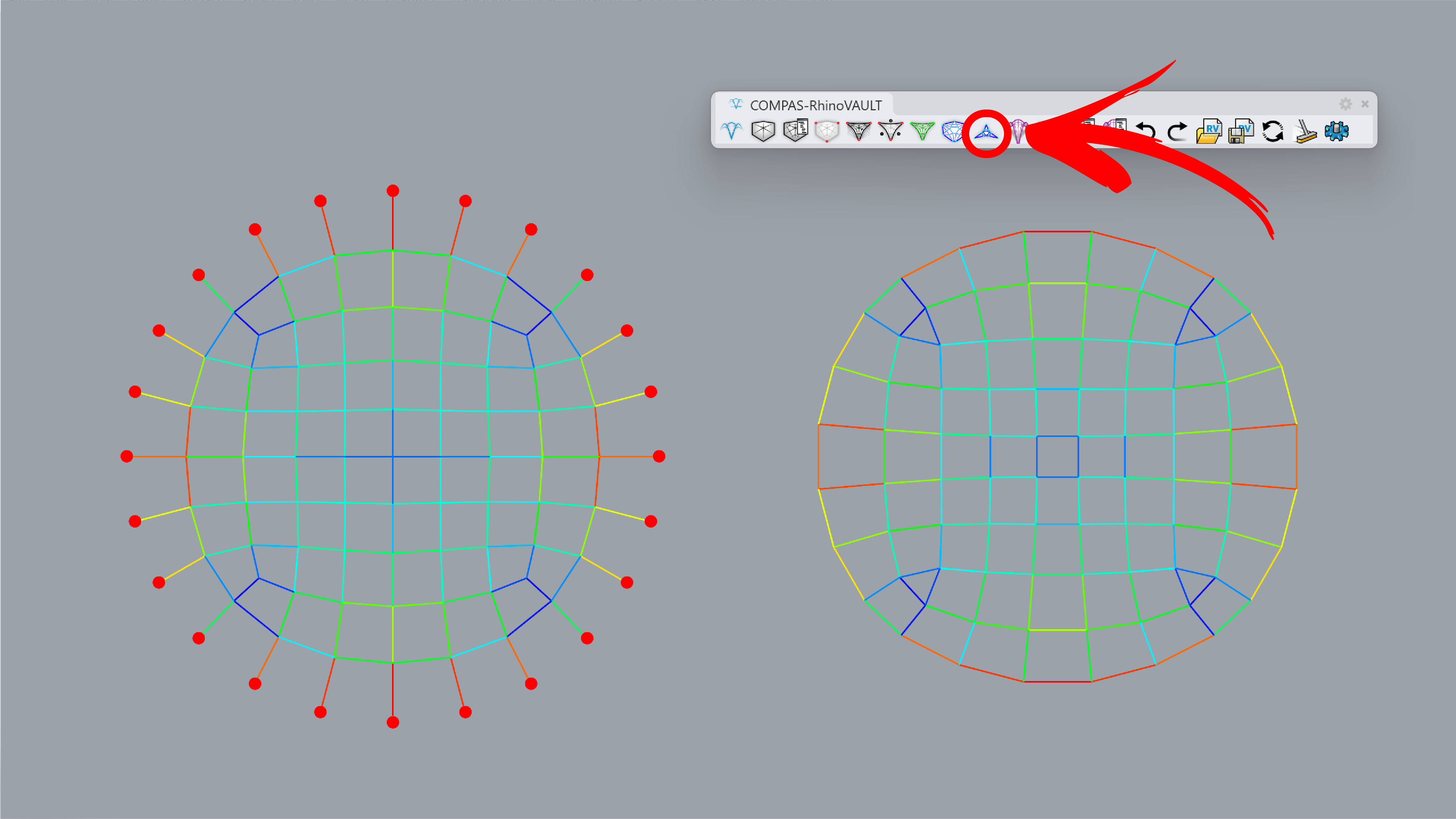
On the right side, the force diagram is created with TextDots marking the angle deviation between the form edge and its 90-degree rotated force edge. In the next step, horizontal equilibrium will be applied to reduce this deviation to zero.
.
{% file src="/files/RycJ8i4Kzeao6k7wJab9" %}
***
## 5. Horizontal Equilibrium
**Command:** `RV_tna_horizontal`
Leave default parameters as is to reach the horizontal equilibrium. Since horizontal segments have almost no force, the force diagram collapses to a line.
{% file src="/files/A2m9d2balJhwe8uEkaez" %}
***
## 6. Vertical Equilibrium
**Command:** `RV_tna_vertical` > `2`
The final geometry is computed by running the vertical equilibrium command, change the height to 2 to match the preview. For preview, we use the following options:`RV_settings > Drawing > show_pipes` and `show_forces`.
{% file src="/files/GR6VchnacSBIRKfm6P17" %}
---
# Agent Instructions
This documentation is published with GitBook. GitBook is the documentation platform designed so that both humans and AI agents can read, navigate, and reason over technical content effectively. Learn more at gitbook.com.
## Querying This Documentation
If you need additional information that is not directly available in this page, you can query the documentation by asking a question.
Perform an HTTP GET request on the following URL with the `ask` and `goal` query parameters:
```
GET https://blockresearchgroup.gitbook.io/rhinovault/examples/historical-typologies/pillow-vault.md?ask=&goal=
```
`ask` is the immediate question: it should be specific, self-contained, and written in natural language.
`goal` is what the user is ultimately trying to achieve, the reason they need the answer. Sharing it helps GitBook give you a better, more relevant answer. A goal is most helpful when it describes the outcome the user wants rather than restating the question. For example, with `ask=how do I create an API token`, a goal like `automate deployments from our CI pipeline` lets GitBook tailor the answer to that use case.
The response will contain a direct answer to the question and relevant excerpts and sources from the documentation.
Use this mechanism when the answer is not explicitly present in the current page, you need clarification or additional context, or you want to retrieve related documentation sections.